

At some point, you have probably noticed trees with roots wrapping around the base of the tree. These are called girdling roots, and they can be incredibly harmful to the tree! They are mostly seen in hand-planted trees, as opposed to ones naturally growing in forests, and are more common in urban environments where space is limited, though they can occur anywhere.
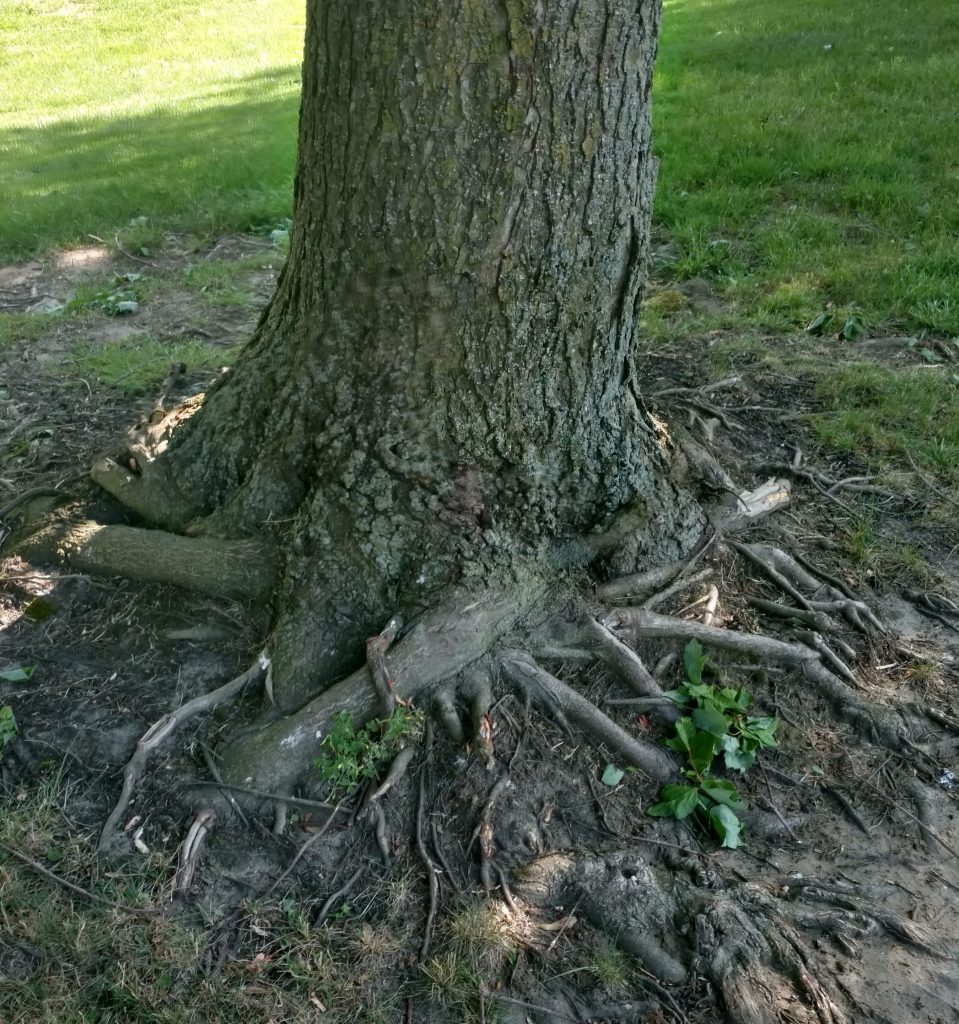
Roots are supposed to grow into the first 18” of the soil, so why do some roots grow around? The biggest culprit is improper planting. Many trees are grown in containers at the nursery, as opposed to balled and burlap (B&B) trees, which are dug up from the ground and wrapped in burlap shortly before being purchased and planted. Container trees are lighter, easier to maneuver, and allow for fall plantings as certain species of trees tend to do poorly when dug up and planted in the fall as a B&B tree. Oftentimes these trees are in their container for months prior to planting, and the roots begin to circle around the pot, as they have nowhere else to go. This is fairly normal, but needs to be remedied before the tree is planted in the ground!
If you’ve ever attended a NJ Tree Foundation tree planting in the fall, you have probably planted container trees with us! You may remember us telling you to cut away, or ‘score’, the roots using a utility knife. It may seem counterintuitive to break up tree roots, but this is actually good! If roots have begun circling the pot, cutting them up will prevent them from continuing to circle, encouraging them to grow outwards instead of around. The planting hole should be approximately three times as large as the trees’ root ball, so the roots are able to grow out. The root flare should be at or above ground level, as planting a tree too deep can also lead to girdled roots. For young trees already in the ground, smaller girdling roots growing at the surface and around the trunk can be removed by using bypass pruners or a hand saw. For more mature trees with girdling roots, always consult a professional. These are far more difficult to remove, and may need to be done in stages so as to not harm the tree.
Now that we know what girdling roots are, what’s so bad about them? Girdling roots put pressure on the trunk of the tree and restrict water and nutrient flow – essentially ‘choking’ the tree. This can sometimes lead to aboveground symptoms such as slow growth, small or discolored leaves, and dieback. They constrict the trees’ growth, and can result in a thinner trunk belowground than aboveground. This creates significant instability as trees rely on their roots and trunk to keep them upright, and the tree is more likely to develop a lean or even fall. In many cases of girdling roots, trees will end up falling at the base, with no roots attached!
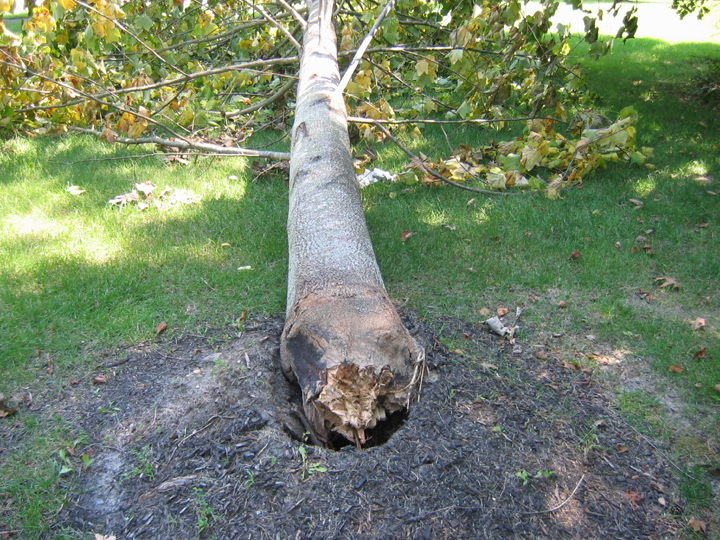
Not all trees with girdling roots will end up falling, but there is no reliable way to tell how girdling roots will affect a particular tree, so it is best to act with caution. Removing badly girdled roots from mature trees can cause a great deal of stress to the tree, so keeping an eye on your tree when it is young and preventing girdling roots in the first place is critical. Double check to make sure your tree is planted at the correct depth. If you can’t see the root flare, it’s too deep! If you are planting a container tree, don’t be afraid to cut away at any circling roots. Make sure you are planting your tree in a large enough space, and that surrounding soil isn’t too compacted so the roots are able to properly spread out. And of course, keep an eye on your tree as it grows. It is far easier to take care of girdling roots when they first appear; waiting years can be costly. As with many tree issues, proper planting, care, and prevention is key – and can save you a lot of trouble down the road!